India's Fertility Rate Plunges Below Replacement Level: A Nation at a Demographic Crossroads
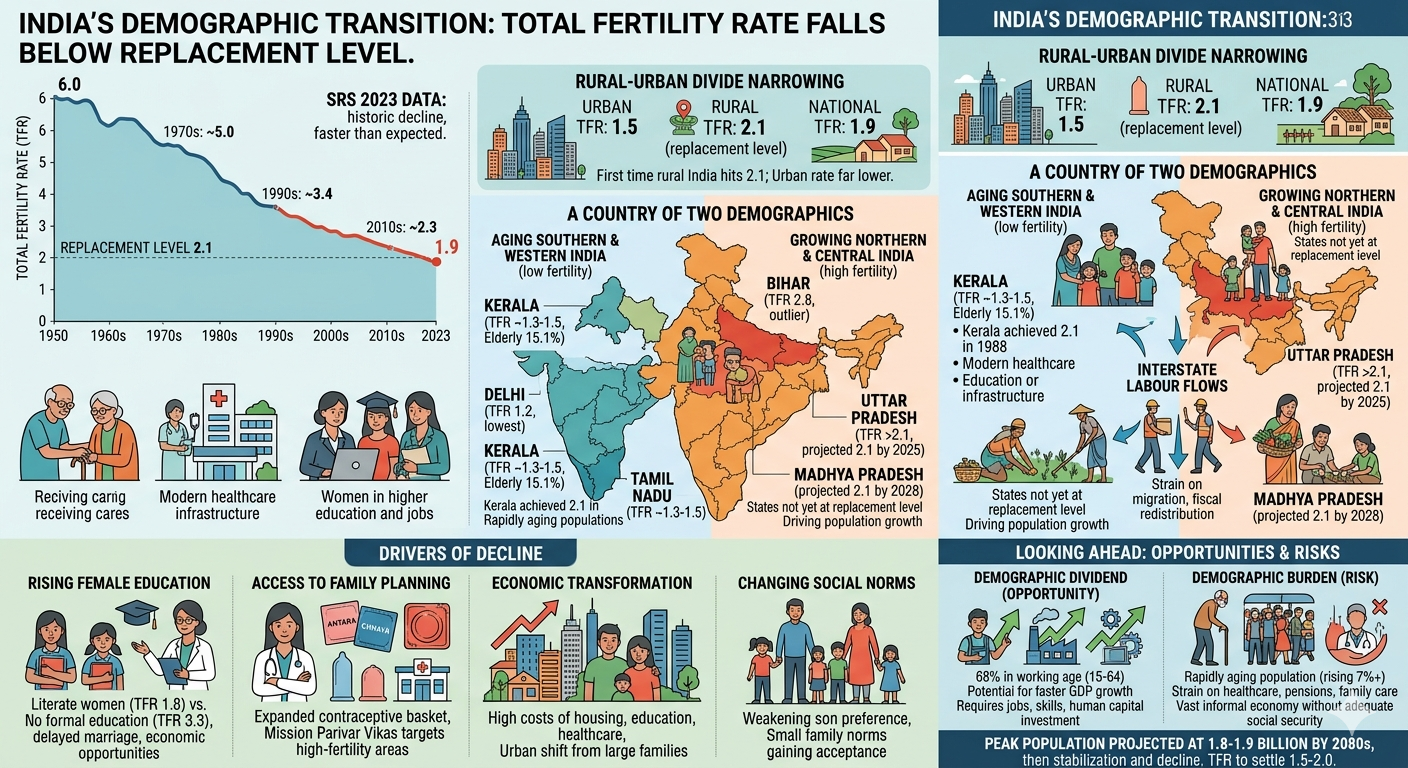
New Delhi — India, long projected to become the world's most populous nation and a demographic powerhouse, has quietly crossed a historic threshold. According to the Sample Registration System (SRS) Statistical Report 2023, India's Total Fertility Rate (TFR) has fallen to 1.9, well below the replacement level of 2.1 — the point at which a population replaces itself from one generation to the next without migration. The milestone, which places India alongside aging European and East Asian economies, is reshaping conversations about the country's future — from economic growth and labor markets to social security and intergenerational care.
The Numbers That Matter
The SRS 2023 data, compiled by the Office of the Registrar General of India, reveals a nation in the midst of one of the fastest demographic transitions in modern history. The national TFR of 1.9 marks a dramatic decline from roughly 6.0 children per woman in the 1950s and 5.0 as recently as the 1970s. In just over two decades, India has halved its fertility rate, a pace that has surprised demographers and policymakers alike.
The rural-urban divide, long a defining feature of India's demographic landscape, is narrowing but remains significant. For the first time on record, rural India has touched the replacement-level TFR of 2.1, while urban areas sit considerably lower at 1.5. The Crude Birth Rate (CBR) stands at 18.4 per 1,000 population, a decline of 0.7 points from 2022 and 1.6 points over the last five years. The divergence between rural and urban India persists — rural CBR at 20.3 remains notably higher than the urban figure of 14.9.
The Gross Reproduction Rate (GRR), which measures the average number of daughters a woman would bear in her lifetime, stands at 0.9 nationally — below the threshold of 1.0 required for natural population replacement. Rural GRR at 1.0 marginally exceeds the replacement mark, while urban GRR has fallen to 0.7, signalling that India's urban female population is already failing to replace itself even without accounting for mortality.
A Country of Two Demographics
India's fertility story is not uniform. It is, in many ways, a tale of two nations moving at different speeds. Eighteen states and union territories now report TFR below the replacement level of 2.1, led by Delhi at 1.2 — the lowest in the country — followed by West Bengal, Tamil Nadu, and Kerala at approximately 1.3 to 1.5. Kerala was the trailblazer, first achieving replacement-level fertility as far back as 1988, setting a template that much of southern and western India would eventually follow.
At the other end of the spectrum, Bihar remains the outlier with a TFR of 2.8, followed by states in the Indo-Gangetic belt and parts of central India. Uttar Pradesh, India's most populous state, is projected to reach replacement-level fertility only in 2025, while Madhya Pradesh may take until 2028. Four states — all concentrated in northern and central India — have yet to achieve replacement-level fertility, and their trajectories will significantly influence India's overall population curve in the coming decades.
This regional divergence has profound implications. Southern states are aging rapidly — Kerala's elderly population (aged 65 and above) has already reached 15.1%, comparable to many developed nations — while northern states continue to contribute disproportionately to population growth. The result is a demographic imbalance that could strain interstate labour flows, fiscal redistribution, and political representation in the decades ahead.
The Education-Fertility Link
One of the most striking patterns in the SRS data is the inverse relationship between female education and fertility. Women with no formal education report a TFR of 3.3 — nearly double the national average — while literate women collectively average 1.8 children. For women with 12 or more years of schooling, the figure drops even further, approaching levels seen in low-fertility European nations.
"Development is inversely proportional to birth rates," says Anil Chandran, General Secretary of the Indian Association for the Study of Population (IASP). "Illiterate groups still have fertility levels above three, but among the educated, TFR ranges between 1.5 and 1.8. This correlation is not coincidental — it reflects delayed marriage, expanded economic opportunities, and fundamentally different life aspirations."
The wealth-fertility gradient tells a similar story. The poorest 20% of India's population has, on average, one more child than the wealthiest quintile. Yet demographers emphasize that fertility has fallen across all income and education groups — even the poorest and least educated women are having fewer children today than their counterparts did a generation ago. The decline is universal; only the pace varies.
Age-specific fertility patterns also reveal a society in transition. The 25-29 age group records the highest fertility rate at 136.8 births per 1,000 women, followed by the 20-24 cohort at 107.5. Fertility among younger women (ages 15-29) has declined sharply, while rates for older women (ages 30-49) have actually increased — a trend driven by delayed marriage and childbearing among educated urban women. Even so, India's median age at first childbirth remains around 21 years, with the majority of births still concentrated among women in their twenties — a notable contrast to developed nations where the thirties have become the prime childbearing decade.
Why Are Indians Having Fewer Children?
The drivers of India's fertility decline are multifaceted and deeply intertwined with broader social and economic change.
Rising female literacy and education stand at the forefront. As girls stay in school longer and pursue higher education, marriage and motherhood are inevitably delayed. Education also changes how women view themselves and their roles — shifting identity from primarily maternal to encompass professional and personal aspirations.
Expanded access to family planning has played a critical enabling role. India's contraceptive basket now includes condoms, oral pills, intrauterine contraceptive devices (IUCDs), injectable contraceptives like Antara, and the non-hormonal pill Centchroman (Chhaya) — options that did not exist or were not widely available a generation ago. The government's Mission Parivar Vikas specifically targets 146 high-fertility districts across seven states and six northeastern states with intensified family planning services.
Economic transformation is another powerful force. Urbanization, rising living costs, and the expansion of service-sector employment have made the traditional large-family model economically impractical for millions. In cities, where housing, education, and healthcare costs have risen sharply, the "one child, maximum two" norm has taken hold even without active promotion.
Changing social norms — particularly the gradual weakening of son preference — have also contributed. While sex-selective practices remain a concern in parts of northern India, the cultural premium on male children has diminished compared to previous generations, reducing the pressure on women to continue bearing children until a son is born.
"The real demographic dividend comes when everyone has the freedom and means to make informed reproductive choices," says Andrea M. Wojnar, UNFPA Representative in India. "India's fertility decline is less a story of top-down population control than of millions of women and couples exercising agency over their own lives."
Looking Ahead: Peak Population and Beyond
Where does India go from here? Demographers at the IASP and international bodies including the United Nations project that India's population — currently estimated at approximately 1.46 billion — will continue growing for several more decades before reaching a plateau.
According to the IASP, India's population is expected to peak at 1.8 to 1.9 billion by around 2080, at which point growth will stabilize and eventually turn negative. The UN's medium-variant projections suggest India will remain below the psychologically significant 2 billion mark, even at peak population. Some projections indicate that absolute population decline could begin as early as 2060, depending on how quickly fertility falls in the remaining high-fertility states.
Crucially, demographers believe India's TFR will not fall indefinitely. The UNFPA's State of World Population Report 2025 projects that India's fertility rate will settle in the 1.5 to 2.0 range over the next 75 years — low, but not catastrophically so. This distinguishes India from East Asian outliers like South Korea, where TFR has collapsed to a world-low of 0.72, or Japan at 1.26.
The Double-Edged Sword
India's fertility transition presents both opportunity and risk — a demographic dividend that must be actively harvested, and a demographic burden that must be proactively managed.
The opportunity is immediate and substantial. With 68% of India's population currently in the working-age bracket of 15 to 64, the country possesses one of the most favourable age structures in the world. A declining dependency ratio — fewer children relative to the working-age population — creates the conditions for accelerated economic growth, provided that education, skills development, and job creation keep pace with the expanding workforce. Economists estimate that India's demographic dividend could add up to 2 percentage points to annual GDP growth if properly leveraged.
Yet the window is narrow and closing. Within two to three decades, the large working-age cohort of today will begin retiring, and the smaller cohorts born during the low-fertility era will enter their prime working years. If India fails to create sufficient productive employment, invest in human capital, and build institutional capacity during this window, the dividend could easily become a liability — a vast population of underemployed youth giving way to a vast population of elderly citizens without adequate social protection.
The challenges on the horizon are formidable. India's elderly population (65 and above) currently stands at 7% of the total but is rising rapidly. Unlike developed nations that aged gradually over a century or more, India's aging process will be compressed into a few decades, straining healthcare systems, pension frameworks, and informal family-based care networks that have historically shouldered the burden of elder support.
The informal nature of India's economy — where the vast majority of workers lack formal pensions, health insurance, or social security — makes this transition particularly fraught. Unlike Europe or Japan, India cannot rely on robust welfare-state institutions to manage the aging transition. The burden will fall heavily on families, communities, and whatever safety nets can be constructed in the intervening decades.
Policy at a Crossroads
India's policy response to this demographic shift is still taking shape. The National Population Policy of 2000, which focused on stabilizing population through maternal and child health improvements, is being superseded by a new policy framework that prioritizes reproductive choice and agency over numerical targets. The upcoming Population Census of 2027 — the first comprehensive census in over two decades, delayed repeatedly by the COVID-19 pandemic and logistical challenges — will provide the definitive data needed to recalibrate policy.
Labour market reforms, pension system expansion, healthcare infrastructure for the elderly, and skills development at scale are all urgent priorities. So too is addressing the regional demographic imbalance — ensuring that labour can flow freely from younger northern states to aging southern economies, and that fiscal transfers account for divergent age structures.
The coming decades will determine whether India's fertility decline becomes a story of squandered potential or successful transition. For now, one thing is clear: the country that once feared a population bomb is learning that the opposite challenge — managing prosperity with fewer people — may prove just as complex.
Sources: Sample Registration System (SRS) Statistical Report 2023, Office of the Registrar General of India; UNFPA State of World Population Report 2025; Indian Association for the Study of Population (IASP); United Nations World Population Prospects.