Kerala's Treasury Is Empty, Coffers Are Drained, and the State Owes Nearly ₹49,000 Crore in Unpaid Bills: A Shocking Fiscal Status Report
By Special Correspondent
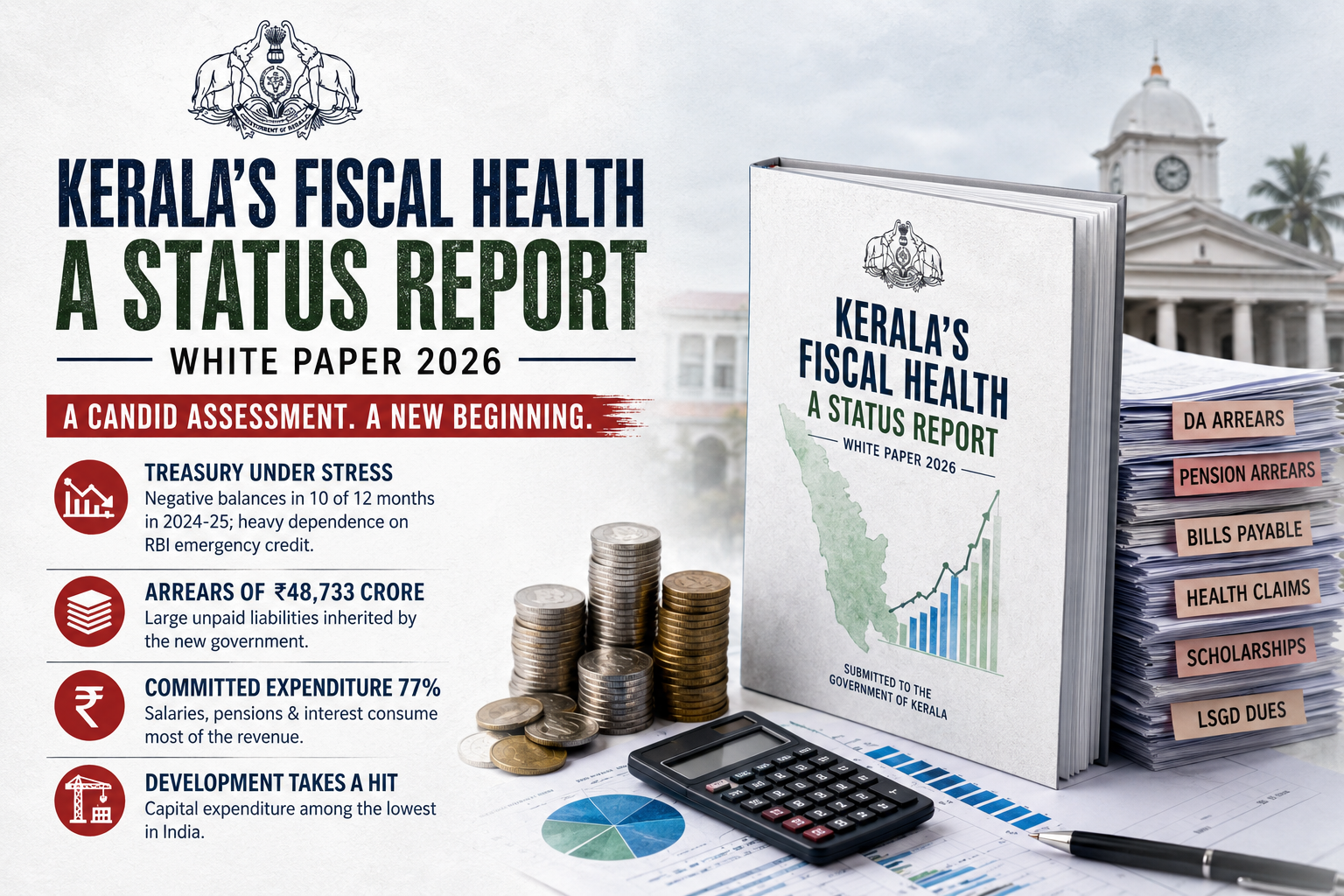
Thiruvananthapuram, June 2026 — A high-powered committee headed by former Cabinet Secretary K.M. Chandrasekhar has delivered a devastating assessment of Kerala's finances in a Status Report submitted to the newly elected Government of Kerala. The document, authored by Chandrasekhar along with Prof. D. Narayana (former Director, Gulati Institute of Finance and Taxation) and Prof. C. Veeramani (Director, Centre for Development Studies), with research support from Prof. M. Parameswaran and Dr. Kiran Kumar Kakarlapudi, reveals a state living beyond its means, borrowing to pay daily bills, saddling the new government with unpaid liabilities of nearly ₹49,000 crore, and watching its development spending collapse while public sector enterprises bleed the exchequer dry.
The report — formally titled "Kerala's Fiscal Health: A Status Report" — is presented as an act of democratic accountability. "In the 2026 elections Kerala voted not merely for change but for a future fulfilling their aspirations beyond basic amenities," the Executive Summary states. "The State's finances are the means of keeping the promise and the Status Report seeks to make a candid assessment of Kerala's finances."
Part I: The Treasury Is Running on Empty
The most alarming finding of the report is the day-to-day cash crisis in the state treasury. Despite budget documents that present a picture of fiscal compliance, the reality on the ground is starkly different.
In the financial year 2024-25, the treasury recorded negative balances in 10 out of 12 months. The government was dependent on the Reserve Bank of India's emergency credit lines — Ways and Means Advances (WMA) and Overdraft — to keep payments flowing for the overwhelming majority of the year.
The data on treasury dependence on RBI credit is damning:
| Year | Days in WMA | Days in Overdraft |
|---|---|---|
| 2011-13 | 0 | 0 (Treasury self-sufficient) |
| 2015 | 18 | 6 |
| 2020 (COVID) | 234 | 57 |
| 2021 | 195 | 35 |
| 2022 | 110 | 14 |
| 2023 | 54 | 1 |
| 2024 | 125 | 67 |
| 2025 | 262 | 84 |
The report notes: "The shift from 2022-23 (one negative month) to 2024-25 (ten negative months) is not a matter of degree — it represents a qualitative change in the State's cash condition."
The 2025 year-end closing balance of ₹6,322 crore was not a sign of fiscal comfort but an optical illusion created by two factors: ₹8,450 crore of Open Market Borrowings (OMB) raised in March alone, and ₹4,969 crore of central transfers received after March 24, 2026. The fragility of this position became apparent immediately: by April 2026 the balance fell to ₹5,264 crore, and by May 16, 2026 — just six weeks into the new financial year — it had dropped further to ₹2,212 crore, a total decline of ₹4,110 crore.
The March Borrowing Problem
The report highlights a structural distortion in Kerala's borrowing pattern: an excessive concentration of OMB in March, the final month of the financial year. In 2023-24, a remarkable 32% of the entire year's market borrowing — ₹13,608 crore — was raised in March alone. In 2024-25 it was 24% (₹12,744 crore). This pattern inflates the year-end cash balance while doing nothing to address the cash stress of the preceding eleven months.
Inherited Arrears: A Mountain of Unpaid Bills
Beyond the daily cash crisis, the new government inherits accumulated payment arrears — obligations already incurred and legally due, but not yet discharged — totalling ₹48,733 crore as of March 31, 2026:
| Category | Amount (₹ Crore) |
|---|---|
| DA Arrears — State employees & teachers | 21,670 |
| DR Arrears — Pensioners | 14,387 |
| Bill Discounting System (Banks & Contractors) | 3,431 |
| UGC DA Arrears — University & College staff | 1,500 |
| SHA/KASP Health Scheme Claims | 2,017 |
| Supplyco | 2,893 |
| KMSCL | 476 |
| SC/ST Scholarship Arrears | 377 |
| LSGD Third Instalment Arrears (2025-26) | 1,982 |
| Total | 48,733 |
The largest component — DA and DR arrears of ₹36,057 crore — is to be settled in eight instalments over four years. But the remaining arrears are immediate obligations. Of the total, ₹21,690 crore is assessed as an immediate additional obligation in 2026-27. As the report starkly notes: "This is almost as large as Kerala's net annual borrowing."
Part II: The Structural Roots — Where the Money Goes
The treasury crisis is not a cash management problem; it is the daily operational manifestation of a deep structural imbalance. The report identifies four structural roots:
1. Committed Expenditure Consumes 77% of Revenue
Committed expenditure — salaries, pensions, and interest payments — consumed 77% of Kerala's revenue receipts in 2024-25, projected at 77% in 2025-26 RE. Against a national average of 46.1%, Kerala's burden is more than one-and-a-half times what comparable states carry.
The three components tell different stories:
- Salaries: Actually fell from 34.5% of revenue receipts (2015-16) to 30.1% (2025-26). This is not the growing problem.
- Pensions: Rose from ~18.9% to 21.5%. Unlike salaries, pension liability is already crystallised and driven by Kerala's large pre-NPS government workforce and longevity trends.
- Interest payments: Tell the most alarming story — rising from 16.1% to 20.9% of revenue receipts, while the major states average remained around 11-12%. The gap more than doubled from 4.3 percentage points in 2015-16 to 8.5 percentage points in 2025-26.
The report notes: "Every year of large open market borrowing adds permanently to the interest obligation in subsequent years. This is the mechanism through which today's borrowing becomes tomorrow's committed expenditure — and tomorrow's committed expenditure becomes the next year's treasury stress."
2. Capital Expenditure Is Among India's Lowest
When three rupees in four of every revenue rupee is pre-committed, capital expenditure is the first casualty. Kerala's capital expenditure stood at 1.3% of GSDP in 2025-26, less than half the national average of 3.2% and the major states average of 3.01%. Kerala invests approximately one-third of what its major state peers invest as a share of their economies.
The C&AG's State Finances Audit Report (2023-24) found that only 5.18% of borrowings during the period were directed towards capital creation; the overwhelming majority financed current consumption and revenue deficits.
3. Revenue Base Is Weakening
Kerala's own tax revenue as a share of GSDP fell from 6.94% in 2015-16 — when it was above the major states average of 6.35% — to 6.41% in 2025-26, now below every benchmark (major states: 7.0%, all states: 7.14%).
State GST performance is particularly poor. At its introduction in 2017-18, Kerala's SGST stood at 1.95% of GSDP against 2.07% major states average. By 2025-26, Kerala is at 2.65% against 3.09% — the gap widened from 0.12 to 0.45 percentage points. In the three years from 2023-24 to 2025-26, Kerala's own tax revenue grew at 8.40% annually — the slowest in the nine-state comparator group.
4. Persistent Non-Compliance with Fiscal Rules
Kerala has run a positive revenue deficit in every single year from 2008-09 to 2025-26 without exception. The State's FRBM law required a zero revenue deficit since 2014-15; the target has never once been met. Outstanding liabilities hit 40.3% of GSDP in 2020-21 and remain at 33.22% in 2025-26 RE, above the indicative ceiling of 33%.
Part III: Budget Credibility in Tatters
The report finds Kerala's budget process suffers from systematic credibility problems that the Budget Manual itself would classify as "defective budgeting."
Revenue Receipts: The actuals of State's Own Tax Revenue are consistently below the budget estimates by around 10% in every single year from 2016-17 to 2025-26. "The budget estimate of SOTR is unmistakably an optimistic guess rather than an estimate based on scientific analysis."
Deficits: Revenue Deficit targets are never met. By 2019-20 Kerala should have eliminated the revenue deficit. Instead, 2025-26 reports a Revenue Deficit of 2.58% of GSDP against a major states average of 0.28%. Fiscal Deficit hit 3.86% (2024-25) and 3.78% (2025-26), exceeding targets.
Plan Expenditure Sleight of Hand: While capital expenditure actuals were below 50% of budget estimates in pre-COVID years, post-COVID plan expenditure actuals are significantly higher than budget estimates (7% to 19% higher). The report calls this "financial sleight of hand" — the actuals include KIIFB and some PSE spending, which the budget estimates do not. "Such 'injudicious' formulations accentuate the already fragile health of the fiscals."
Central Transfer Shock: The 2026-27 Interim Budget assumed central transfers approximately ₹20,500 crore higher than what materialised. The shortfall comprises:
- Share of Central Taxes: shortfall of ₹5,959 crore (2.8% assumed vs. 2.382% awarded)
- Revenue Deficit Grants: shortfall of ₹14,138 crore (XVI Finance Commission awarded zero)
- Others: shortfall of ₹604 crore
The plan expenditure for 2026-27 BE is estimated at ₹33,183 crore, which is likely to be reduced by ₹20,000 crore. "This has significant implications for the plan size... with its severe consequences for the minorities."
Part IV: KIIFB — A Parallel Government with ₹56,000 Crore in Liabilities
The Kerala Infrastructure Investment Fund Board (KIIFB), established in 2016 as an off-budget borrowing vehicle, represents one of the most serious structural problems in Kerala's fiscal architecture.
The C&AG Bombshell
The C&AG audit for 2024-25 fundamentally changed KIIFB's status. The audit concluded that since KIIFB's debt is serviced not from its own revenues but from budgetary allocations — the Consolidated Fund of the State — and since KIIFB lacks a sufficient independent revenue base, its debt is effectively state debt. Consequently, KIIFB borrowings must count against the state's Annual Borrowing Ceiling.
As the report states: "KIIFB was created precisely to mobilise market resources outside the budget framework, circumventing FRBM constraints. If KIIFB's borrowings count against the state's borrowing limit, then the entire off-budget mechanism loses its purpose."
The Financial Position (As of March 31, 2026)
KIIFB's finances reveal a deeply leveraged position:
Inflows (₹ Crore):
| Source | Amount |
|---|---|
| Government Contribution (MV Tax share, Fuel cess, etc.) | 26,497 |
| Borrowings (Term loans, Masala Bond, Domestic bonds, HUDCO/PFC/REC loans) | 42,053 |
| Project Repayments | 3,700 |
| Other Income | 1,921 |
| Total Inflows | 74,171 |
Outflows (₹ Crore):
| Destination | Amount |
|---|---|
| Principal Repayment | 9,866 |
| Finance Cost (Interest + Guarantee Commission) | 10,198 |
| Project-Related Payments | 42,905 |
| Administrative Expenses | 571 |
| Total Outflows | 63,540 |
Fund Balance: ₹10,722 crore
Unmet Loan Liability: ~₹21,000 crore
Projects Still to be Funded: ~₹35,000 crore
Total State Obligation (KIIFB): ~₹56,000 crore
Borrowing Cost: Higher Than the Government's
A key justification for KIIFB was that it would borrow more cheaply than the government. The data show the opposite. In every year except COVID-hit 2020-21, KIIFB's borrowing cost was at least 1 to 1.5 percentage points higher than what the state paid. On a ₹42,000 crore borrowing portfolio, even a one-percentage-point differential represents excess annual interest of approximately ₹420 crore.
Skewed Project Distribution
KIIFB's project distribution raises serious questions:
- Kannur district alone accounts for over 20% of total approved amounts and 19% of payments
- Thiruvananthapuram (17% approved, 17% released)
- Ernakulam (11%)
- Three districts absorb nearly half the total
"Neither human development indices nor economic need indices provide an obvious justification for this concentration."
Sectorally, 68% of approved amounts flow to just three departments: Public Works (34%), Industry (25%), and Health (9%). Education, water supply, sanitation, and local infrastructure are systematically neglected.
Governance Irregularities
- A 2017 government order conferred ex-officio Secretary powers on the KIIFB CEO — a structural irregularity corrected only in 2025
- 50% of Motor Vehicle Tax (₹3,300 crore in 2025-26 alone) is diverted to KIIFB, violating the constitutional principle that all revenues must flow to the Consolidated Fund
- Masala Bond issuance costs of over ₹11 crore lack supporting documentation
- Consultancy payments through the CMD lack transparency
- In several years, borrowed funds were deposited back with banks, incurring unnecessary costs
Part V: Public Sector Enterprises — A Fiscal Hemorrhage
Kerala has 132 active Public Sector Enterprises (PSEs) — the largest number among Indian states. But far from being assets, they represent a chronic drain on the exchequer.
The Scale of Losses
- Accumulated losses increased from ₹31,571 crore in 2021-22 to ₹78,851 crore in 2024-25
- Government investment in PSEs: ₹44,846 crore (2024-25)
- Just 5 enterprises account for 86% of total investment
- In 2024-25, KSRTC, KSSPL, and KWA accounted for 72% of the net loss
- The majority of PSEs have seen their net worth eroded, with many turning deeply negative
The Three Bleeding Utilities
Kerala State Electricity Board Limited (KSEBL):
- Negative net worth: ₹35,149 crore
- Only ~25% of electricity requirement met through internal generation; 75% purchased externally at higher cost
- Cost per unit of electricity supplied exceeds revenue per unit — a persistent gap
- Withheld electricity duty collected from consumers for three decades instead of remitting it to the Consolidated Fund
- The reported "profit" of ₹212 crore in 2022-23 was actually the government taking over KSEBL's losses to meet power sector performance conditions
Kerala State Road Transport Corporation (KSRTC):
- Negative net worth: ₹19,821 crore
- Annual loss: ₹1,580 crore (2024-25)
- Accumulated losses: ₹20,961 crore
- Loan repayment arrears to the government: ₹11,679 crore (principal ₹8,959 crore + interest ₹2,720 crore), dating back to 1983-84
- KSRTC alone accounted for 44.2% of PSE net losses in 2024-25
Kerala Water Authority (KWA):
- Accumulated losses: ₹7,157 crore — more than doubled in six years
- Annual loss: ₹318 crore (2024-25)
- Loan repayment arrears to government: ₹3,930 crore
- Despite losses, net worth has not yet turned negative (₹14,828 crore positive)
The Budgetary Burden
PSEs receive substantial budgetary support while returning negligible dividends:
| Year | Dividend/Profit from PSEs | Budgetary Support to PSEs |
|---|---|---|
| 2020-21 | ₹110 crore | ₹4,570 crore |
| 2021-22 | ₹228 crore | ₹1,655 crore |
| 2022-23 | ₹49 crore | ₹1,445 crore |
| 2023-24 | ₹243 crore | ₹1,642 crore |
| 2024-25 | ₹249 crore | ₹1,504 crore |
Part VI: Development Spending Collapses — The Poor Pay the Price
The report's most poignant finding is that fiscal adjustment falls heaviest on the most vulnerable. "For the affluent, the government is often a regulator; for the poor, it is frequently a provider, employer, educator, healer, and insurer of last resort. Therefore, every fiscal crisis becomes a crisis for the poor."
Plan Expenditure in Decline
- Plan expenditure as a share of total expenditure fell from 21.84% (2015-16) to 17.55% (2025-26 RE)
- In nominal terms, plan expenditure has stagnated despite inflation and growth
Composition Shift: Social Services Squeezed
The composition of plan expenditure reveals a disturbing shift:
| Category | 2017-18 | 2025-26 (RE) |
|---|---|---|
| Social Services | 53.78% | 30.68% |
| Economic Services | 38.29% | 47.52% |
| General Services | 2.53% | 16.13% |
The share of social services — education, health, welfare of disadvantaged sections — collapsed by 23 percentage points. General services (administration, public order) expanded more than six-fold.
SC/ST Welfare Decimated
The share of plan expenditure for the welfare of SC/ST/OBC and minorities:
- Fell from 9.24% (2017-18) to just 3.85% (2025-26 RE)
- The mandated share based on population is 12.64% (SC: 9.81%, ST: 2.83%)
- The actual spending of 3.85% is barely one percentage point above what STs alone are entitled to
Under the Scheduled Caste Sub Plan (SCSP): Expenditure never exceeded 90% of the outlay, and fell to just 49.6% in 2019-20.
Under the Tribal Sub Plan (TSP): Expenditure never exceeded 85% of the outlay, declining to 55.7% in 2019-20.
KIIFB completely neglected these communities: SC Department projects received only ₹92 crore approved (0.07% of total) and ₹64 crore released (0.07%). ST Department projects received ₹49 crore approved (0.04%) and ₹18 crore released (0.02%). "They are an insignificant dot in the map of KIIFB spending."
Part VII: The Way Forward — 12 Recommendations
The Committee offers a comprehensive reform agenda:
1. KIIFB Reform: Bring KIIFB fully under budgetary control of the Finance Department. Stop its independent external borrowing — the Finance Department should borrow at lower rates and channel funds. Amend the 2016 KIIFB Act. Conduct a C&AG performance audit immediately. Preserve useful capacities (Institutional Finance Group for local body bonds, project monitoring systems, ESG expertise).
2. PSU Restructuring: Commission separate studies for KSEBL, KSRTC, and KWA. Expand electricity generation capacity through solar (6,000 MW), pumped hydro (8,000 MW), and nuclear options. Open the power sector to private and Central PSU investment. Merge Kerala State Beverages Corporation with Civil Supplies Corporation to offset losses against profits.
3. Salaries and Pensions: Raise the retirement age to match the Government of India (saves ~₹6,000 crore per year of increase). Limit Pay Commissions to once in 10 years. Appoint professional chairpersons for PSUs for minimum 3-5 year terms.
4. Employment Generation: Reform land and labour laws. Promote IT, AI, higher education, tourism, and coastal development. Allow private and foreign universities. Deploy unused estates and buildings for educational institutions.
5. GST Collection: Commission a detailed study to expand tax collection, particularly SGST. Enable local bodies to issue bonds for infrastructure spending.
6. State Planning Board: Restructure as a government think tank. Process feasible ideas from across the state. Organise civil society organisations as a "second line" to strengthen government work. Monitor projects and submit monthly Cabinet reports. Maintain links with NITI Aayog.
7. Administration: Introduce a performance management system linked to budget. Speed up Secretariat file movement. Complete digitisation (not just digitalisation of existing forms) within three months per department. Simplify forms and procedures.
8. Welfare Pensions: Replace KSSPL distribution with Aadhaar-linked Direct Benefit Transfer.
9. Centre-State Relations: Work with similarly placed states to demand a fairer fiscal framework. Push for restrictions on cesses and surcharges that shrink the divisible pool.
10. Consultants and Recruitment: Rationalise the number of consultants. All appointments to parastatals and government departments must be through the Kerala State Selection and Recruitment Board.
11. Local Bodies in Growth: Link plan fund devolution to performance parameters including investment promotion and solid waste management.
12. Urban Local Government: Reorganise local self-government based on latest population figures, creating more municipal bodies as Kerala is highly urbanised.
Conclusion: Reform or Perish
The report ends on a note of urgency tempered with optimism. "In the long run, there is a limit to how much we can address the problem by tightening our belts. The best way forward is to put in place measures to promote growth, investment and employment. In the absence of adequate resources with the State, the solution lies in resolutely encouraging private investment, cooperative investment and through local governments raising funds from the market."
It calls for opening the power sector to private investment, recasting land and labour laws, focusing on industrial infrastructure, and making local governments active agents of industrial promotion, as was done in China. The cooperative sector's potential — with Primary Agricultural Credit Societies (PACS) having a credit base of about ₹1.3 lakh crore — must be harnessed.
"Reform is a continuous process. Liberalisation, which commenced in real earnest in India in 1991, is still ongoing. This status paper is intended to generate new thinking, which, in turn, will bring a stream of reforms in its wake to build a new Keralam."
The question is whether Kerala's political establishment has the will to confront these hard truths — or whether, as the report warns, the State will continue borrowing to pay yesterday's bills while tomorrow's Kerala is mortgaged.
The Status Report was prepared by a Committee chaired by Shri K.M. Chandrasekhar, IAS (Retd.), former Cabinet Secretary to the Government of India, with Prof. D. Narayana (former Director, GIFT), Prof. C. Veeramani (Director, CDS), Prof. M. Parameswaran (CDS), and Dr. Kiran Kumar Kakarlapudi (GIFT). Shri K.R. Jyothilal, IAS, Additional Chief Secretary (Finance), served as Convener. The report was submitted to Chief Minister and Finance Minister V.D. Satheeshan.