Strategic Rift: The "Hellhole" Controversy and the Future of India-US Synergy
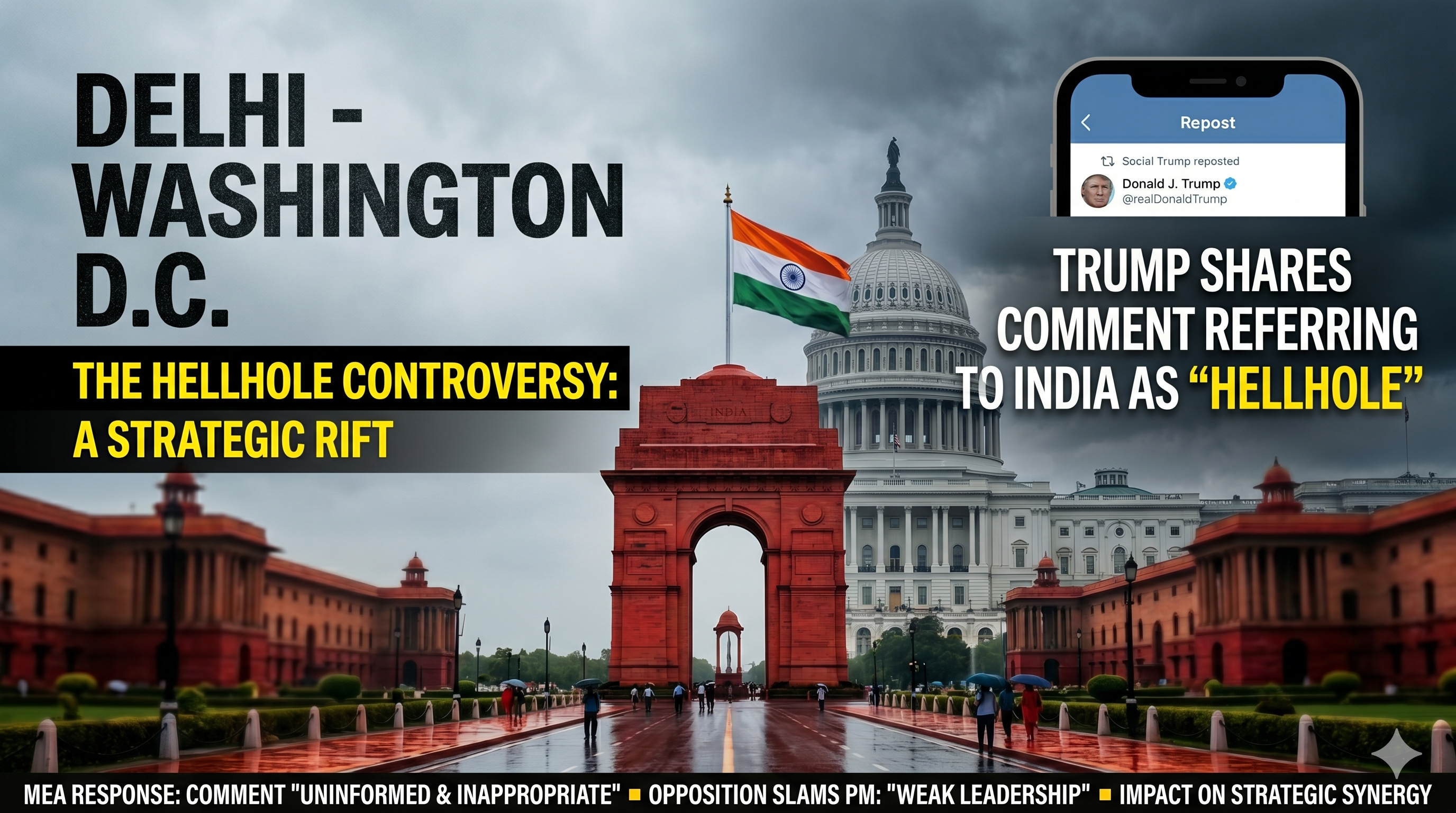
NEW DELHI / WASHINGTON D.C. — The diplomatic landscape between the world’s oldest and largest democracies has entered a period of intense volatility. As of April 24, 2026, a single social media repost by President Donald Trump has threatened to overshadow months of painstaking negotiations on trade and technology. Dubbed the "Hellhole Controversy," the incident has exposed the fragile balance between personal leader-to-leader chemistry and national dignity.
- The Incident: A Social Media Firestorm
The friction began on April 22, 2026, when President Trump shared a transcript of a podcast featuring conservative host Michael Savage. The post, aimed at bolstering Trump’s campaign to end birthright citizenship, specifically singled out migrants from India and China.
"A baby here becomes an instant citizen, and then they bring the entire family in from China or India or some other hellhole on the planet." — Transcript shared by Donald Trump.
While the White House has framed the post as a critique of "chain migration" policies rather than a targeted slur against India, the damage was immediate. For an Indian administration that has heavily marketed the "Vishwa Mitra" (Global Friend) image, being categorized as a "hellhole" by a close strategic partner was a significant blow.
- India’s Response: Diplomatic "Steel"
The Ministry of External Affairs (MEA), led by External Affairs Minister S. Jaishankar, moved from initial silence to a stern formal rebuke. MEA spokesperson Randhir Jaiswal stated on Thursday that the remarks were "uninformed, inappropriate, and in poor taste."
Despite the rhetoric, New Delhi is performing a delicate balancing act. Prime Minister Modi has notably refrained from a personal counter-attack, likely to protect the multi-billion dollar trade and defense deals currently on the table.
- Political Backlash: The Opposition’s "Weak PM" Narrative
The Indian opposition has wasted no time in turning this into a domestic political crisis for the ruling BJP.
Congress Party: Congress President Mallikarjun Kharge accused PM Modi of "pin-drop silence" in the face of national humiliation, questioning why the "Abki Baar Trump Sarkar" camaraderie hasn't bought India more respect.

The "Weak PM" Label: Senior leader Supriya Shrinate and Shama Mohamed have trended the hashtag #WeakPM, arguing that Modi's personal diplomacy with Trump is a "one-way street" where India gives concessions and receives insults.

Trinamool Congress (TMC): Mahua Moitra sarcastically asked if the government would "summon the US Ambassador over tea" or simply ignore the slur to keep trade talks alive.
Strategic Rift: The "Hellhole" Controversy and the Future of India-US Synergy
NEW DELHI / WASHINGTON D.C. — The diplomatic landscape between the world’s oldest and largest democracies has entered a period of intense volatility. As of April 24, 2026, a single social media repost by President Donald Trump has threatened to overshadow months of painstaking negotiations on trade and technology. Dubbed the "Hellhole Controversy," the incident has exposed the fragile balance between personal leader-to-leader chemistry and national dignity.
- The Incident: A Social Media Firestorm
The friction began on April 22, 2026, when President Trump shared a transcript of a podcast featuring conservative host Michael Savage. The post, aimed at bolstering Trump’s campaign to end birthright citizenship, specifically singled out migrants from India and China.
"A baby here becomes an instant citizen, and then they bring the entire family in from China or India or some other hellhole on the planet." — Transcript shared by Donald Trump.
While the White House has framed the post as a critique of "chain migration" policies rather than a targeted slur against India, the damage was immediate. For an Indian administration that has heavily marketed the "Vishwa Mitra" (Global Friend) image, being categorized as a "hellhole" by a close strategic partner was a significant blow. 2. India’s Response: Diplomatic "Steel"
The Ministry of External Affairs (MEA), led by External Affairs Minister S. Jaishankar, moved from initial silence to a stern formal rebuke. MEA spokesperson Randhir Jaiswal stated on Thursday that the remarks were "uninformed, inappropriate, and in poor taste."
Despite the rhetoric, New Delhi is performing a delicate balancing act. Prime Minister Modi has notably refrained from a personal counter-attack, likely to protect the multi-billion dollar trade and defense deals currently on the table. 3. Political Backlash: The Opposition’s "Weak PM" Narrative
The Indian opposition has wasted no time in turning this into a domestic political crisis for the ruling BJP.
Congress Party: Congress President Mallikarjun Kharge accused PM Modi of "pin-drop silence" in the face of national humiliation, questioning why the "Abki Baar Trump Sarkar" camaraderie hasn't bought India more respect.

The "Weak PM" Label: Senior leader Supriya Shrinate and Shama Mohamed have trended the hashtag #WeakPM, arguing that Modi's personal diplomacy with Trump is a "one-way street" where India gives concessions and receives insults.

Trinamool Congress (TMC): Mahua Moitra sarcastically asked if the government would "summon the US Ambassador over tea" or simply ignore the slur to keep trade talks alive.
4. The Stakes: Trade, Oil, and the "Pax Silica"
The controversy comes at a critical juncture for three major pillars of the relationship: A. The 18% Tariff Reset
In February 2026, the US and India reached an Interim Trade Agreement. The US agreed to slash the overall punitive tariff on Indian goods from nearly 50% down to 18%. In exchange, India agreed to:
Halt Russian oil purchases.

Shift energy sourcing to the US.

Commit to $500 billion in future US product imports.
The "Hellhole" comments have now led to calls in the Indian Parliament to pause these concessions.
Strategic Rift: The "Hellhole" Controversy and the Future of India-US Synergy
NEW DELHI / WASHINGTON D.C. — The diplomatic landscape between the world’s oldest and largest democracies has entered a period of intense volatility. As of April 24, 2026, a single social media repost by President Donald Trump has threatened to overshadow months of painstaking negotiations on trade and technology. Dubbed the "Hellhole Controversy," the incident has exposed the fragile balance between personal leader-to-leader chemistry and national dignity.
- The Incident: A Social Media Firestorm
The friction began on April 22, 2026, when President Trump shared a transcript of a podcast featuring conservative host Michael Savage. The post, aimed at bolstering Trump’s campaign to end birthright citizenship, specifically singled out migrants from India and China.
"A baby here becomes an instant citizen, and then they bring the entire family in from China or India or some other hellhole on the planet." — Transcript shared by Donald Trump.
While the White House has framed the post as a critique of "chain migration" policies rather than a targeted slur against India, the damage was immediate. For an Indian administration that has heavily marketed the "Vishwa Mitra" (Global Friend) image, being categorized as a "hellhole" by a close strategic partner was a significant blow. 2. India’s Response: Diplomatic "Steel"
The Ministry of External Affairs (MEA), led by External Affairs Minister S. Jaishankar, moved from initial silence to a stern formal rebuke. MEA spokesperson Randhir Jaiswal stated on Thursday that the remarks were "uninformed, inappropriate, and in poor taste."
Despite the rhetoric, New Delhi is performing a delicate balancing act. Prime Minister Modi has notably refrained from a personal counter-attack, likely to protect the multi-billion dollar trade and defense deals currently on the table. 3. Political Backlash: The Opposition’s "Weak PM" Narrative
The Indian opposition has wasted no time in turning this into a domestic political crisis for the ruling BJP.
Congress Party: Congress President Mallikarjun Kharge accused PM Modi of "pin-drop silence" in the face of national humiliation, questioning why the "Abki Baar Trump Sarkar" camaraderie hasn't bought India more respect.

The "Weak PM" Label: Senior leader Supriya Shrinate and Shama Mohamed have trended the hashtag #WeakPM, arguing that Modi's personal diplomacy with Trump is a "one-way street" where India gives concessions and receives insults.

Trinamool Congress (TMC): Mahua Moitra sarcastically asked if the government would "summon the US Ambassador over tea" or simply ignore the slur to keep trade talks alive.
4. The Stakes: Trade, Oil, and the "Pax Silica"
The controversy comes at a critical juncture for three major pillars of the relationship: A. The 18% Tariff Reset
In February 2026, the US and India reached an Interim Trade Agreement. The US agreed to slash the overall punitive tariff on Indian goods from nearly 50% down to 18%. In exchange, India agreed to:
Halt Russian oil purchases.

Shift energy sourcing to the US.

Commit to $500 billion in future US product imports.
The "Hellhole" comments have now led to calls in the Indian Parliament to pause these concessions.
B. The Strait of Hormuz & Iran
The geopolitical backdrop is further complicated by the crisis in West Asia. Following the collapse of US-Iran talks in Islamabad on April 11, 2026, Trump ordered a US naval blockade of the Strait of Hormuz.
India's Role: India is caught in the middle. While it demands "unimpeded freedom of navigation," it has also pursued quiet bilateral talks with Iran to secure passage for Indian-flagged tankers.

The Irony: Trump’s administration needs India’s navy to help police the region, even as his social media rhetoric alienates the Indian public.
C. Pax Silica: The New Technology Order
In late February 2026, India formally joined Pax Silica, a US-led alliance focused on securing the "Silicon Stack" (semiconductors, critical minerals, and AI).
GPU Security: For engineers and architects, this alliance is the backbone of future hardware availability. The current controversy threatens the "trusted partner" status required for sharing top-tier AI tech like Blackwell GPUs and next-gen fabs.
The Road Ahead
The arrival of US Secretary of State Marco Rubio in May 2026 is now being viewed as a "cleanup mission." If the US doesn't offer a more formal clarification, the opposition's pressure may force PM Modi to toughen his stance, potentially stalling the most significant economic realignment between the two nations in decades.